


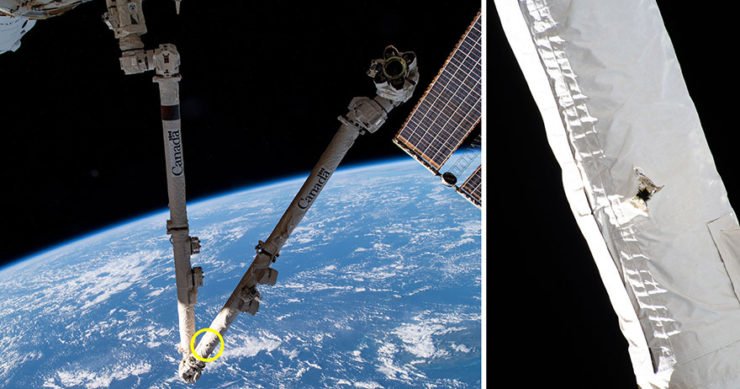
The International Space Station on Friday steered trying to save itself from garbage traveling in its direction. This is the most recent occurrence in a progression of occasions that have compromised the wellbeing of space travelers and the flying research facility because of space garbage drifting in zero-gravity.
Calls to screen and manage space flotsam and jetsam, or space garbage, have developed since Russia led an enemy of satellite rocket test a month ago. This created a garbage field in a circle that U.S. authorities said would represent a danger to space exercises for quite a long time. The choice to bring down the circle of the space station was taken to guarantee the wellbeing of the space travelers ready, to whom there was no danger as asserted by Nasa.
Nasa has said that the garbage, named object 39915, was produced during the separation of a Pegasus rocket dispatched on May 19, 1994. The separation occurred on June 3, 1996, and garbage has been drifting in the vacuum all over the world from that point forward.
Roscosmos said the station’s circle, in an unscheduled move completed by mission control, dropped by 310 meters (339 yards) for almost three minutes to stay away from a nearby experience. He let Reuter knows that the move would not influence the arranged dispatch of the Soyuz MS-20 rocket on Dec. 8 from the Baikonur cosmodrome in Kazakhstan and its docking at the ISS.
The episode came hours after two space travelers directed an almost six-drawn-out spacewalk outside the station to fix a messed-up radio wire. The two space explorers should do the task Tuesday, however, Nasa postponed the spacewalk as a result of conceivably undermining space garbage. Not set in stone the space explorers were protected to go out, notwithstanding a marginally expanded danger of a penetrated suit from satellite destruction. Space trash comprises of disposed of dispatch vehicles or portions of a rocket that float around in space and hazard crashing into satellites or the ISS.
